Is there a best delta for covered calls?
Delta sets the trade-off in a covered call between premium now and the chance your shares are sold. Here is how each level pays on a hypothetical $50 stock.
Short answer
There is no single best delta for covered calls. Delta sets a trade-off between premium now and the chance your shares are called away. Many sellers work between about 0.15 and 0.35. Lower deltas pay less and are assigned less often. Higher deltas pay more and give up more of any rally.
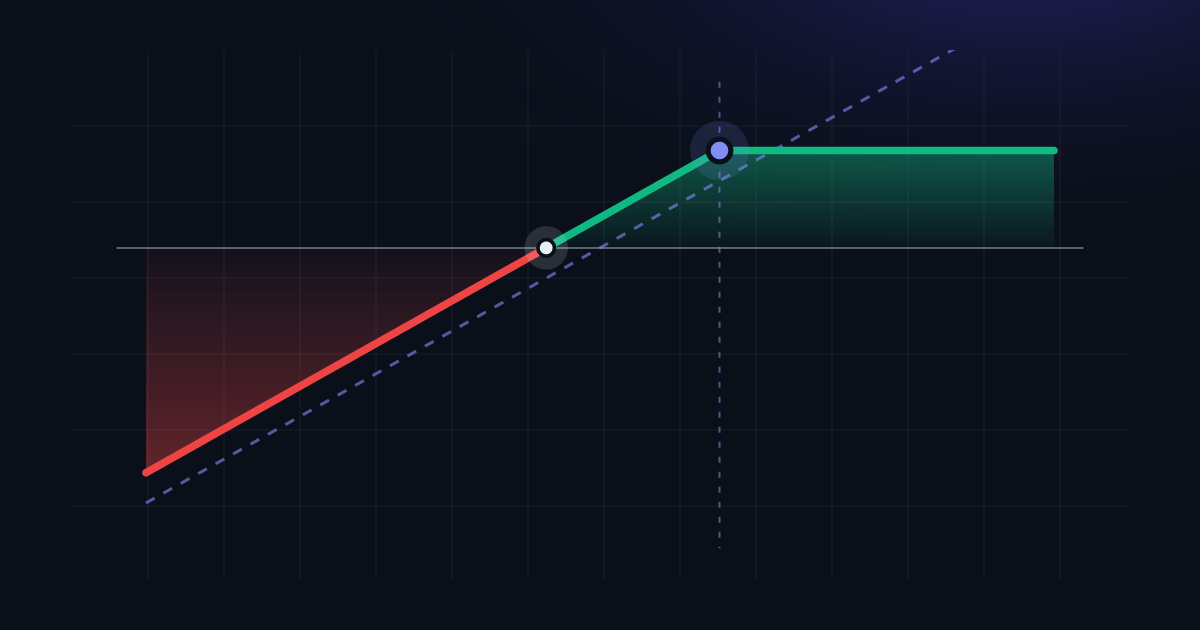

The post in 35 seconds, drawn from the text and figures below.
The idea in one picture
Delta measures how much an option's price moves when the stock moves $1. A call with a delta of 0.30 gains about 30 cents when the stock rises a dollar. The Options Industry Council notes that some traders also read delta as a rough probability the option ends in the money. A 0.30-delta call is, very loosely, a three-in-ten chance your shares are sold at expiration. Option delta explained covers where that shortcut comes from and where it misleads.
For a covered call, that gives delta two jobs at once.
- It sets the premium. Calls closer to the stock price have higher deltas and cost more, so you collect more.
- It sets how much of the stock you still own in effect. 100 shares carry a delta of 100. Selling one 0.30-delta call subtracts 30, so the position behaves like 70 shares for small moves. Sell a 0.50-delta call and it behaves like 50.
So picking a delta is picking how much of the stock's upside you are willing to rent out, and at what price. There is no answer that is right for everyone, only one that matches what you want the shares to do.
Delta is a dial between income now and upside later. Set it on purpose.
Try it
Here is a hypothetical stock at $50. You own 100 shares and sell one 30-day call with a $53 strike for $0.70 a share, which is a delta of about 0.28. Move the slider to see the position at expiration, then picture the strike closer or further away.
A hypothetical example, not a real quote. Value at expiration for one contract (100 shares), before commissions and taxes, for shares bought at the stock price shown.
The flat section on the right starts at the strike. A higher-delta call moves that corner closer to today's price and raises the whole line a little, because you collected more. A lower-delta call pushes the corner out and lowers the line, because you collected less.
A worked example
The table prices four 30-day calls on the same hypothetical $50 stock with a standard model at 30% implied volatility. One contract covers 100 shares, so the shares cost $5,000.
| Strike | Delta | Premium per share | Premium for 100 shares | Premium on $5,000 | Most you can make if called | Rough chance of finishing in the money |
|---|---|---|---|---|---|---|
| $50 | 0.53 | $1.80 | $180 | 3.6% | $180 | about 1 in 2 |
| $52 | 0.35 | $0.98 | $98 | 2.0% | $298 | about 1 in 3 |
| $53 | 0.28 | $0.70 | $70 | 1.4% | $370 | about 1 in 4 |
| $55 | 0.15 | $0.33 | $33 | 0.7% | $533 | about 1 in 8 |
The last column uses the model's own probability, which sits a little below delta. Both are estimates from option prices, not forecasts.
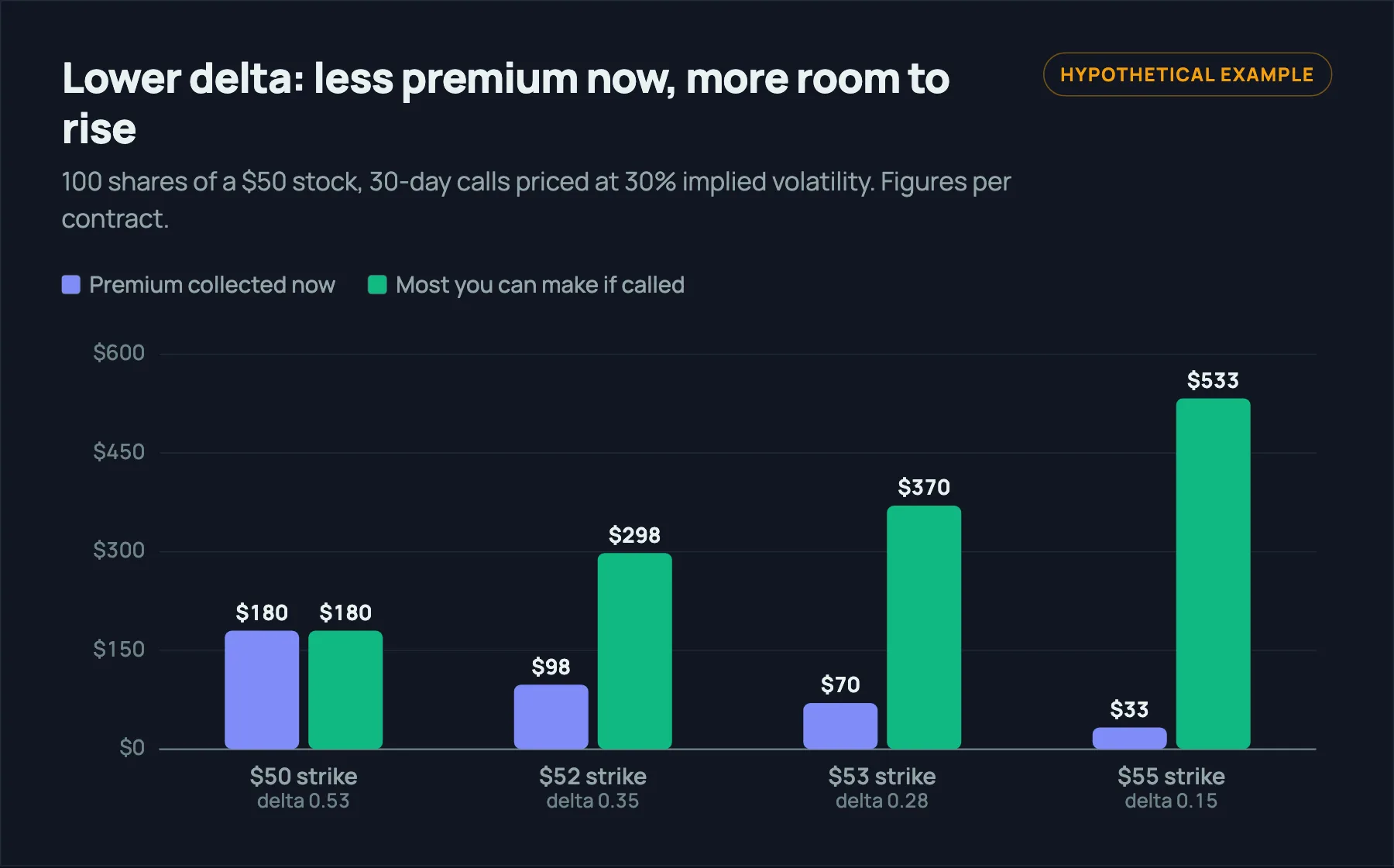
The table above as a chart. Hypothetical prices from a standard model at 30% implied volatility.
Read the table in both directions.
Going down, premium falls fast. The 0.15-delta call pays less than a fifth of the at-the-money call. On a falling stock, that premium is your only cushion, so a low delta gives you very little protection.
Going up, the most you can make shrinks. The at-the-money call pays the most premium but caps the trade at $180, because any rise in the stock belongs to the buyer. The 0.15-delta call pays $33 but leaves room for $533 if the stock runs to $55.
Now think in months rather than single trades. If you sold the 0.15-delta call every month, you might expect the shares to be called away roughly once or twice a year. At 0.50, it would be about every other month. Neither is wrong. They are different strategies wearing the same name.
A rough way people map delta to intent:
- About 0.10 to 0.20. You mainly want to keep the shares and collect a little extra. Assignment would be a surprise.
- About 0.25 to 0.35. You want meaningful income and would accept selling at the strike.
- About 0.40 to 0.55. You would be glad to sell soon and want the most premium for agreeing to.
Whichever band you use, check that the premium is worth the commitment. How much option premium is enough gives a way to judge that against the capital tied up.
When it goes wrong
Delta moves. A call sold at 0.25 delta can be 0.60 a week later if the stock rallies. How fast it changes is gamma, and gamma is highest near the strike and close to expiration. Option gamma explained shows why a short-dated call can go from comfortable to in the money in a single day.
The same delta means different strikes in different markets. When implied volatility is high, a 0.30-delta call sits further from the price and pays more. When it is low, the same delta sits closer and pays less. A fixed delta rule hides that change, so it helps to look at the strike and the premium, not only the Greek.
Earnings distort the picture. Before an earnings report, premiums are inflated because the market expects a bigger move. A 0.20-delta call can look generous right up until the stock gaps through the strike. Earnings and IV crush explains what happens to the price of that call after the report.
Chasing premium on a falling stock. If the shares drop, the strike you could sell at your original delta is now below your cost. Selling it locks in a loss if you are assigned. Many sellers choose a lower delta or skip a month instead.
Rolling is not free. Buying back a call that has gone against you to sell a later one can work, but each roll is a new trade with new risk. How to roll an options trade walks through when it makes sense and when it only delays a loss.
If you are still choosing between calls on shares you own and puts on cash you hold, covered call vs cash-secured put compares the two on the same hypothetical stock.
Before you place the trade
- You know what you want from the shares, to keep them or to sell them.
- You picked a delta band that matches that goal, before looking at premiums.
- You checked the strike and premium, not only the delta number.
- You know whether an earnings date falls before expiration.
- You know the next ex-dividend date, since it raises early-assignment risk.
- The strike is above your cost basis, or you accept selling at a loss.
- You have a plan for a rally through the strike, either let it go or roll.
Questions people ask
Is a 0.30 delta covered call a 30% chance of assignment?
Roughly, and only as a starting point. Delta is a sensitivity measure that happens to approximate the chance of finishing in the money. The market-implied probability is usually a little lower, and early assignment can happen before expiration, most often just before a dividend.
Should the delta change with the expiration date?
The number can stay the same, but its meaning changes. A 0.30-delta weekly call is much closer to the stock price than a 0.30-delta call two months out, and it can move into the money far faster.
Why do some sellers use very low deltas?
They want to keep the shares, often for taxes or a long-term view, and treat the premium as a small extra. The cost is that premium at 0.10 or below can be too small to matter after a bad month in the stock.
Does a higher delta mean more income?
More premium per trade, yes. Not necessarily more income over time, because higher-delta calls are assigned more often, and each assignment ends the position unless you buy shares back, possibly at a higher price.
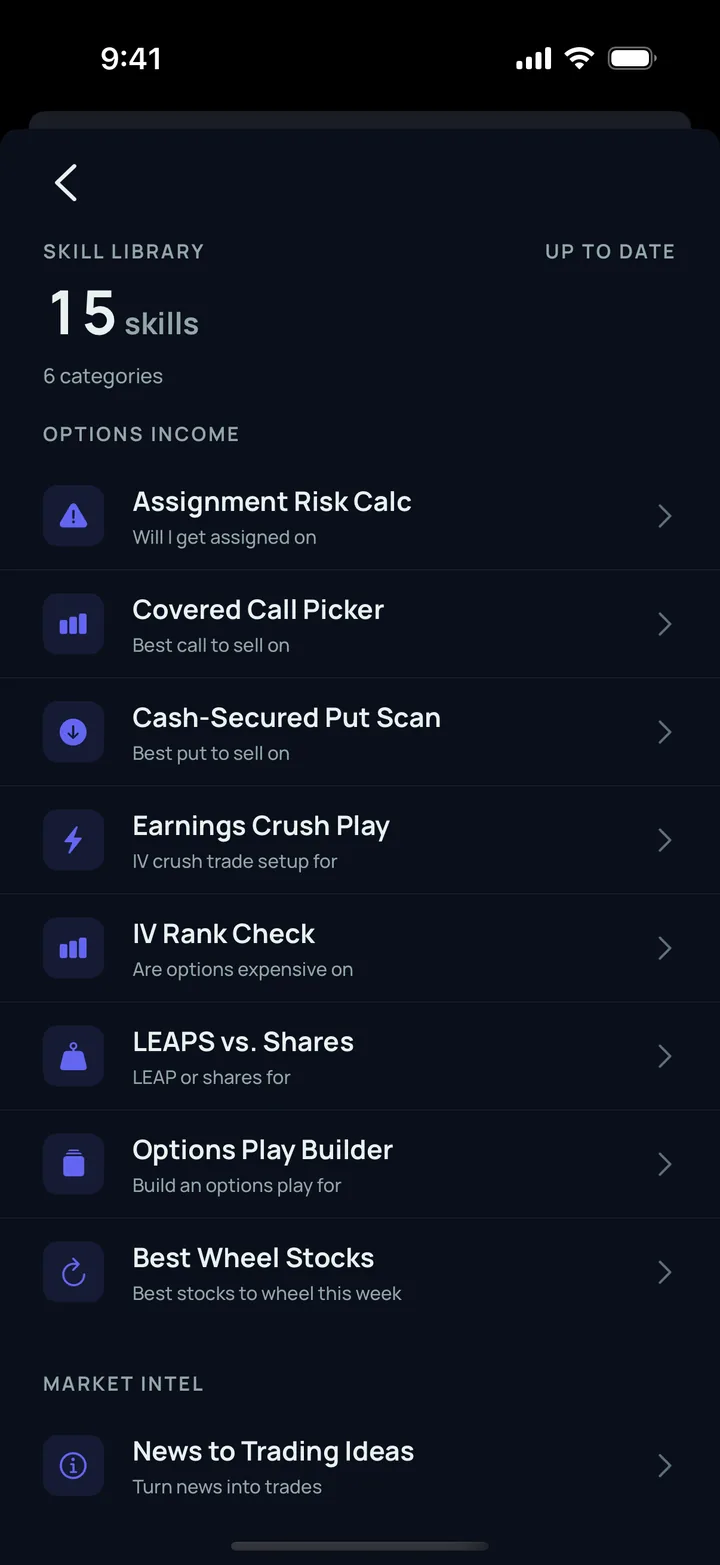
Picking a strike is the same trade-off on every stock: premium now against room to rise. The skill library groups the options income checks together, including a covered call picker and an assignment risk calculator.
The research skill library in the iOS app, captured in September 2026.
Sources
One market note a week
What moved, what reports next, and one idea worth reading. No trade signals.
Keep reading
Covered call vs cash-secured put which fits you?
A covered call and a cash-secured put have nearly the same payoff. What differs is where you start, what it costs and what you want to happen next.
· 7 min read
Are covered calls worth it? the math on one trade
Covered calls are worth it when you would gladly sell at the strike and expect a flat or slowly rising stock. See the math on a hypothetical $50 stock.
· 8 min read
April 2026 product update: the options income tracker
What the options income tracker does as of November 2026, checked against the product, from the trades table and alerts to wheel cycles, imports and plans.
· 6 min read