Covered call vs cash-secured put which fits you?
A covered call and a cash-secured put have nearly the same payoff. What differs is where you start, what it costs and what you want to happen next.
Short answer
In the covered call vs cash secured put choice, the risk is nearly the same. Both earn a premium and both lose money if the stock falls. The difference is the starting point. A covered call suits shares you already own and would sell higher. A cash-secured put suits cash you would spend on the stock lower.
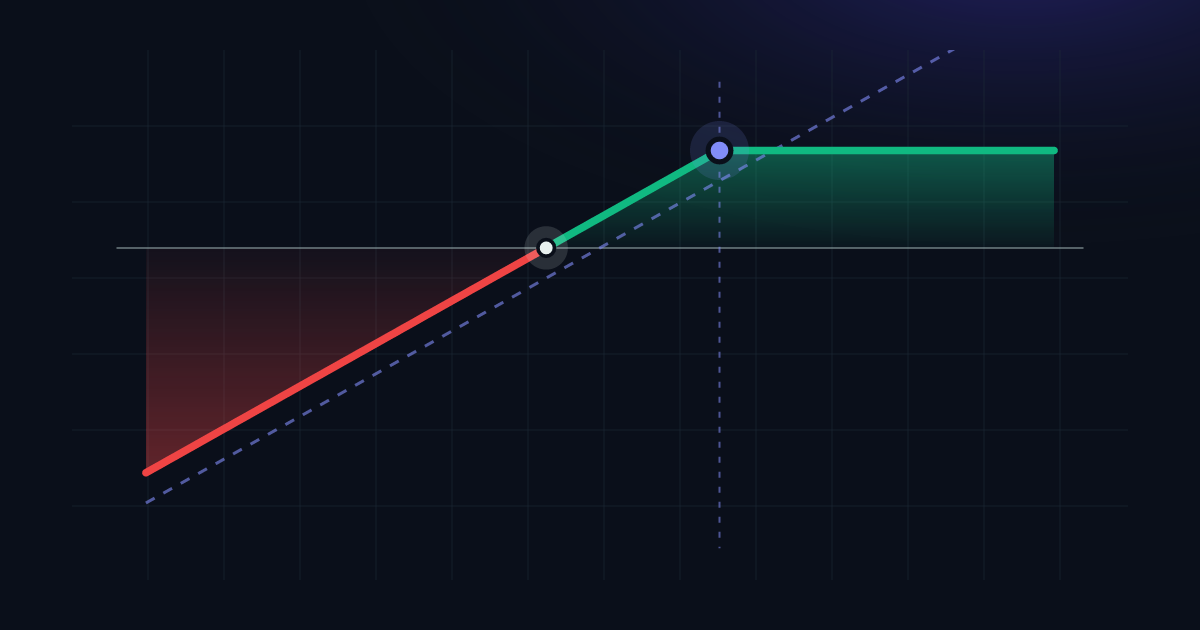
The idea in one picture
A covered call is two things at once: you own 100 shares, and you sell someone the right to buy them from you at a set price (the strike) by a set date. A cash-secured put is the mirror image: you hold enough cash to buy 100 shares, and you sell someone the right to sell them to you at the strike by a set date. In both trades you are paid the premium up front, and it is yours whatever happens next.
Draw the profit and loss of each at expiration and the two lines have the same shape. Gains are capped at roughly the premium, and losses grow as the stock falls. That is not a coincidence. A long stock position plus a short call behaves almost exactly like a short put at the same strike, a relationship called put-call parity. The small gap between them comes from interest on the cash and from any dividend the stock pays.
So the real question is not which trade is safer. It is which one starts from where you already are, and which outcome you would rather have if the option is exercised. If either strategy is new to you, what a covered call is and what a cash-secured put is cover the mechanics from the beginning.
Same shape, different starting point. Pick the one that begins where you already are.
Try it
Here is a hypothetical stock at $50 with options 30 days from expiration. The first chart is a covered call: 100 shares plus one $52 call sold for $0.98 a share. The second is a cash-secured put: one $48 put sold for $0.82 a share, with $4,800 set aside. Move each slider to see the position at expiration.
A hypothetical example, not a real quote. Value at expiration for one contract (100 shares), before commissions and taxes, for shares bought at the stock price shown.
A hypothetical example, not a real quote. Value at expiration for one contract (100 shares), before commissions and taxes.
Notice where each line bends. The covered call goes flat above $52, because your shares are sold there. The put goes flat above $48, because the put expires worthless and you keep the premium. Below those points both lines fall dollar for dollar with the stock.
A worked example
The premiums above come from a standard pricing model with the hypothetical stock at $50, 30 days to expiration and 30% implied volatility. Both strikes are about the same distance from the stock price, one above and one below.
| Covered call ($52 strike) | Cash-secured put ($48 strike) | |
|---|---|---|
| What you start with | 100 shares, $5,000 | $4,800 in cash |
| Premium collected | $98 | $82 |
| Break-even at expiration | $49.02 | $47.18 |
| Most you can make | $298 (premium plus $2 a share up to the strike) | $82 (the premium) |
| Result if the stock ends at $56 | +$298, shares sold at $52 | +$82, no shares |
| Result if the stock ends at $50 | +$98, shares kept | +$82, no shares |
| Result if the stock ends at $45 | minus $402, shares kept | minus $218, shares bought at $48 |
Two things stand out.
First, the covered call makes more when the stock rises, because you keep the stock's gain up to the strike. The put earns only its premium no matter how high the stock goes.
Second, the put loses less when the stock falls, because its strike sits below the stock price. You are agreeing to buy at $48, not at $50. That cushion is the trade-off for the smaller premium.
Now line them up at the same strike to see the parity at work. At a $50 strike the model prices the call at $1.80 and the put at $1.64. A $50 covered call earns at most $180; a $50 cash-secured put earns at most $164. The $16 gap is roughly what $5,000 earns in interest over a month at the model's 4% rate. The two trades are close to the same bet, written two ways. How far from the price to place the strike is a separate decision, and what delta to sell covered calls at lays out that trade-off with numbers.
What separates them in practice:
- Dividends. The covered call writer owns the shares and collects any dividend. The put seller does not. Covered calls on dividend stocks explains how this shifts the math, and why it raises early-exercise risk.
- Interest. Cash held against a put can often sit in a money market fund or Treasury bills while the trade is open, depending on the broker.
- Taxes. Selling an ordinary out-of-the-money call usually leaves the holding period of your shares alone, but some in-the-money calls can suspend it. A put has no shares behind it yet, so there is no holding period to protect.
- Approval. Some brokers allow covered calls at their lowest options approval level and ask for a higher one for puts, even fully secured ones.
Many traders end up using both in sequence: sell puts until assigned, then sell calls on the shares until they are called away. That cycle is the wheel strategy. A public log of options income trades, with premium, win rate and yield on the capital at work, shows what many cycles of both look like together.
When it goes wrong
Both trades fail the same way: the stock falls a long way. The premium is small next to the position. In the example, $98 or $82 of premium stands against roughly $5,000 of exposure. If the hypothetical stock drops to $35, the covered call writer is down $1,402 and the put seller, assigned at $48, is down $1,218. The premium is the only protection either has.
Each also has its own way to disappoint.
- The covered call caps a rally. If the stock jumps to $65, the shares go at $52. You keep $298 and watch $1,300 of further gain go to the buyer of the call.
- The put can miss the stock entirely. If the stock rises, you collect $82 and never own the shares you wanted. Selling puts as a way to buy a stock only works if you are content with the premium as the consolation prize.
- Early assignment. Either option can be exercised before expiration. For calls this is most common the day before an ex-dividend date; for puts it is most common when the put is deep in the money. Options assignment risk covers when it tends to happen.
- Earnings. Premiums swell before an earnings report because the market expects a larger move. A larger premium is payment for a larger risk, not a free bonus.
Before you place the trade
- You know which you hold today, shares or cash, and the trade starts from that.
- For a covered call, you would be content to sell your shares at the strike.
- For a cash-secured put, you would be content to buy the shares at the strike.
- You have worked out the break-even price, not only the premium.
- You know the next earnings date and the next ex-dividend date.
- The position is a size you could hold through a large drop.
- Your broker has approved your account for the strategy you picked.
Questions people ask
Is a cash-secured put safer than a covered call?
Not in any meaningful sense. At the same strike and expiration the two have almost the same payoff, and both lose most of their value if the stock falls sharply. A put with a strike below the stock price loses less than a covered call bought at today's price, but it also earns less when the stock rises.
Which earns more premium?
At the same strike, the call usually earns slightly more than the put, by roughly the interest on the cash minus any dividend. Out-of-the-money options at equal distances above and below the price are not directly comparable, because the stock can drift and implied volatility often differs by strike.
Can I do both on the same stock?
Yes. Selling a covered call on shares you own and a cash-secured put below the price at the same time is sometimes called a covered strangle. It doubles your exposure to the stock, because a fall can leave you with twice the shares.
What happens to the premium if I am assigned?
You keep it either way. On a covered call the premium adds to the sale price of your shares. On a put it lowers the effective price you paid for the shares, which is why the break-even in the example is $47.18 rather than $48.
Which delta should I pick for either trade?
There is no single right number. Lower delta means less premium and a lower chance of assignment. The trade-off is laid out with numbers in what delta to sell covered calls at.
Eight seconds from the app explainer: an analyst run lists a covered call, a cash-secured put and a bull put spread for the week. The trades are sample data, labelled on screen, and are not recommendations.
Sources
One market note a week
What moved, what reports next, and one idea worth reading. No trade signals.
Keep reading
April 2026 product update: the options income tracker
What the options income tracker does as of November 2026, checked against the product, from the trades table and alerts to wheel cycles, imports and plans.
· 6 min read
Is there a best delta for covered calls?
Delta sets the trade-off in a covered call between premium now and the chance your shares are sold. Here is how each level pays on a hypothetical $50 stock.
· 7 min read
Are covered calls worth it? the math on one trade
Covered calls are worth it when you would gladly sell at the strike and expect a flat or slowly rising stock. See the math on a hypothetical $50 stock.
· 8 min read