How to read a Form 4 insider filing
How to read Form 4 insider filings box by box, what each transaction code means, and how to tell an informative purchase from a routine planned sale.
Short answer
How to read Form 4: start with who filed it and their role, then go to Table I. For each line, read the transaction code, the shares, whether they were acquired or disposed of, the price and the holding afterwards. Code P, an open-market purchase, usually says the most. Then check the footnotes and the Rule 10b5-1 box.

A Form 4 is the report a company insider files when they buy, sell or otherwise change their holding of the company's stock. It is required by Section 16 of the Securities Exchange Act of 1934, and it is public on the SEC's EDGAR system. Learning how to read Form 4 filings takes a few minutes, and most of the skill is telling the handful of informative transactions from the many routine ones.
Who has to file a Form 4, and when?
Officers, directors and owners of more than 10% of a company's registered stock file a Form 4 within two business days of a trade. Section 16 covers those three groups: a company's officers, its directors, and anyone who owns more than 10% of a class of its registered equity. The SEC's investor bulletin sets out the three forms they file.
| Form | When | What it reports |
|---|---|---|
| Form 3 | Within 10 days of becoming an insider | Initial holdings |
| Form 4 | Before the end of the second business day after a transaction | Each change in holdings |
| Form 5 | Within 45 days after the company's fiscal year end | Transactions that were exempt from Form 4 or were not reported earlier |
2 business days
How long an insider has to file a Form 4 after a trade
Officers, directors and owners of more than 10% of a class of registered stock file before the end of the second business day after the transaction.
Source: SEC Investor Bulletin: Insider Transactions and Forms 3, 4, and 5
The two-business-day deadline is what makes Form 4 useful. A trade on a Monday is usually public by Wednesday evening. Compare that with members of Congress, who have up to 45 days to report, as covered in how late Congress can report a stock trade.
What does each box on a Form 4 mean?
The six numbered boxes at the top identify who filed, which company, and the filer's relationship to it.
- Box 1, Name and address of reporting person. The insider, or sometimes a fund or trust that is the legal owner.
- Box 2, Issuer name and ticker. The company whose stock changed hands.
- Box 3, Date of earliest transaction. The first trade the form reports. One form can cover several days.
- Box 4, If amendment. A date here means this form corrects an earlier one.
- Box 5, Relationship to issuer. Director, officer (with title), 10% owner or other. A chief executive's trade and a director's trade can mean different things.
- Box 6, Individual or joint filing. Whether more than one person reports on the same form.
Two checkboxes sit above the boxes. One says the filer is no longer subject to Section 16. The other, added in 2023, says a transaction was made under a Rule 10b5-1 plan, a pre-arranged trading plan adopted in advance. Instruction 10 asks the filer to give the plan's adoption date in the footnotes.
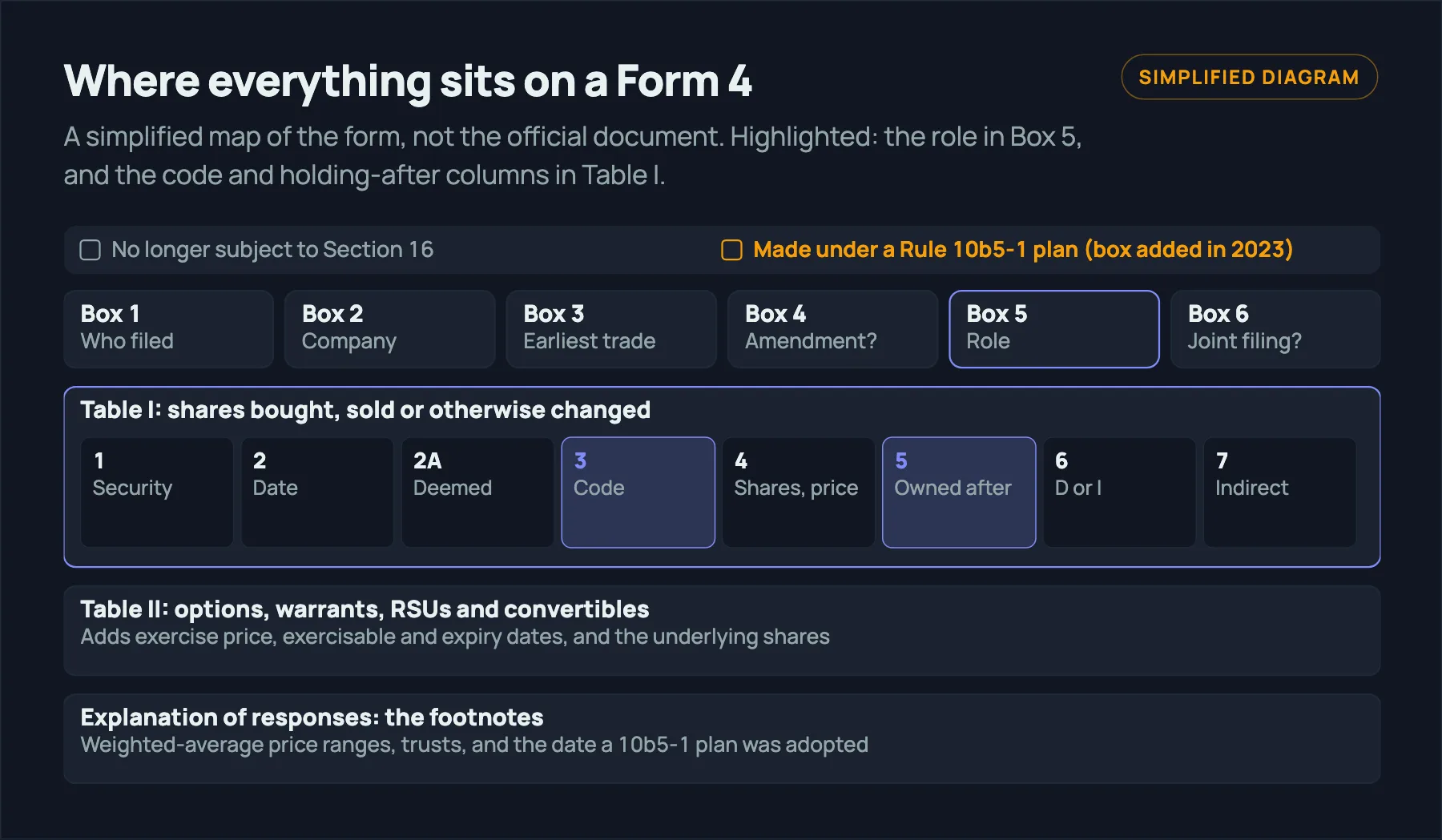
A simplified map of the form, drawn for this guide. The official Form 4 and its instructions are on SEC.gov.
What does Table I on a Form 4 show?
Table I shows each purchase, sale or other change in ordinary shares, one transaction per line. It covers ordinary shares, which the form calls non-derivative securities. Each line is one transaction.
| Column | What it shows |
|---|---|
| 1. Title of security | Usually "Common Stock" |
| 2. Transaction date | The trade date |
| 2A. Deemed execution date | Used for some plan trades; often blank |
| 3. Transaction code | What kind of transaction it was (see below) |
| 4. Amount, (A) or (D), price | Shares, acquired or disposed of, and the price per share |
| 5. Amount owned following | The holding after this line |
| 6. Ownership form | D for direct, I for indirect |
| 7. Nature of indirect ownership | For example, a family trust |
Column 5 is the one people skip and should not. A sale of 5,000 shares means one thing for someone left holding 500,000 and something else for someone left holding 2,000.
What does Table II on a Form 4 show?
Table II shows changes in options, warrants, restricted stock units and convertible securities. Its columns add an exercise price, the dates the instrument can be exercised and expires, and the number of underlying shares. The most common pattern is an option exercise: a line in Table II showing options disposed of, matched by a line in Table I showing shares acquired at the exercise price.
Which Form 4 transaction codes matter most?
Code P, an open-market purchase, matters most; most other codes record pay, exercises and tax withholding. The general instructions to Form 4 list every code. These are the ones you will see most.
| Code | Meaning | How much it usually tells you |
|---|---|---|
| P | Open-market or private purchase | The most. The insider chose to spend their own money. |
| S | Open-market or private sale | Some, depending on size and whether it was planned |
| A | Grant or award from the company | Little. It is pay. |
| M | Exercise or conversion of a derivative, such as an option | Little on its own; look at what happens to the shares next |
| F | Shares withheld to pay the exercise price or tax | Little. It is usually automatic on vesting. |
| G | Gift | Little |
| D | Disposition back to the company | Little |
| J | Other, explained in a footnote | Read the footnote |
The SEC's bulletin notes that insiders may sell for any number of reasons, including liquidity and diversification. An open-market purchase has fewer ordinary explanations, which is why code P lines get the most attention.
What does a routine Form 4 look like next to an informative one?
A routine filing usually pairs an option exercise with a planned sale; an informative one is an unplanned open-market purchase. Here is a hypothetical Form 4 from the chief financial officer of a hypothetical company whose stock trades near $50. None of it describes a real person or company.
| Table | Code | Shares | (A) or (D) | Price | Owned after |
|---|---|---|---|---|---|
| II | M | 10,000 options | D | $20.00 exercise | 30,000 options |
| I | M | 10,000 | A | $20.00 | 95,000 |
| I | S | 10,000 | D | $50.12 (footnote: weighted average, range $49.80 to $50.40) | 85,000 |
The Rule 10b5-1 box is checked, and a footnote gives the plan's adoption date as several months earlier.
Read together, the three lines say this: the officer exercised options at $20 and sold the same number of shares at about $50, pocketing the difference. Their stock holding ends where it started, at 85,000 shares, and the sale was scheduled months ago. This is a routine exercise-and-sell, and on its own it says very little about the officer's view of the company.
Now a second hypothetical filing, from a director of the same company:
| Table | Code | Shares | (A) or (D) | Price | Owned after |
|---|---|---|---|---|---|
| I | P | 5,000 | A | $50.00 | 25,000 |
No plan box is checked. The director spent about $250,000 of their own money on the open market and raised their holding by a quarter. That is the kind of line worth noticing, though it is still one person's decision and not a forecast.
What are the common mistakes when reading a Form 4?
Most mistakes come from reading the headline number without the code, the plan box and the holding left afterwards.
- Counting every sale as a signal. Most sales are option exercises, tax withholding or planned sales. Check the code, the plan box and the holding afterwards.
- Ignoring the price footnote. Many filers report a weighted average price and give the range in a footnote. The headline price is not one trade.
- Missing indirect holdings. Shares held through a trust or a family member are marked I in column 6. They still belong in the picture.
- Reading one filing alone. A pattern across several insiders, all buying in the open market, carries more information than a single filing. One executive's purchase can be a gesture.
- Forgetting amendments. A Form 4/A replaces an earlier form. Read the latest version.
Insider activity is one step in a wider check of a company; how to research a stock in 20 minutes puts it in order, and how to read a 10-K covers the annual report the same insiders sign off on. Congressional trades follow a different set of rules, and the congressional trades section of the home page shows those reports beside each other. Each company page in the stock directory is a place to start.
What should you check before reading anything into a Form 4?
- You know the filer's role, officer, director or large holder.
- You read the transaction code on every line, not just the headline.
- You checked whether the Rule 10b5-1 box is ticked.
- You compared the shares traded with the holding left afterwards.
- You matched any option exercise in Table II with its line in Table I.
- You read the footnotes for price ranges, trusts and plan dates.
- You looked for other insiders' filings around the same dates.
Questions people ask
How quickly must a Form 4 be filed?
Before the end of the second business day after the transaction, in most cases. A few transactions can be deferred to Form 5, which is due within 45 days after the fiscal year ends.
Where can I find Form 4 filings?
On the SEC's EDGAR system. Search the company or the insider by name and filter the results for Form 4. Each filing has a readable version and the underlying data file.
What does a Rule 10b5-1 plan mean on a Form 4?
The trade was made under a written plan adopted in advance, which lets insiders trade on a schedule set before they had any particular news. Planned sales usually tell you less than unplanned purchases.
Does a large insider sale mean the stock will fall?
No. Insiders sell to pay taxes, diversify, buy a house or follow a pre-set plan. A sale is worth a closer look when it is large relative to the holding, unplanned, and matched by other insiders selling at the same time.
Sources
One market note a week
What moved, what reports next, and one idea worth reading. No trade signals.
Keep reading

How to read a 10-K in 15 minutes
How to read a 10-K in 15 minutes. Which items to open, in what order, what to skip, and the warning signs in the filing worth slowing down for.
· 8 min read
How to research a stock a 20-minute checklist
How to research a stock before you buy in about 20 minutes, using the annual report, three financial statements, insider filings and one written thesis.
· 9 min read
Three frameworks for evaluating earnings quality
Earnings quality is how well reported profit reflects cash and lasting business. Three checks, on cash, revenue and margins, using a company's own filings.
· 8 min read