How to research a stock a 20-minute checklist
How to research a stock before you buy in about 20 minutes, using the annual report, three financial statements, insider filings and one written thesis.
Short answer
How to research a stock in 20 minutes comes down to five questions. What does the company sell, is it growing, is the profit backed by cash, can it survive a bad year, and what are you paying? Answer each from the annual report, then write one sentence on why you would buy and what would change your mind.

This is a first pass, not a full valuation. Its job is to tell you whether a stock deserves a deeper look, and to stop you buying something you cannot explain. Every source below is free, and most of it is in one document: the company's annual report on Form 10-K, which you can pull from the SEC's EDGAR search.
Key takeaways
- Nine steps, eight answered from public filings, most of them from the annual report on Form 10-K.
- One strong year can be a one-off; three years of revenue and cash flow show a direction.
- A valuation multiple means little until it is compared with the company's own history and two or three peers.
- Open-market purchases by insiders carry more information than routine planned sales.
- The written thesis needs a second sentence, what would change your mind, or there is no point at which the idea is wrong.
What are the steps to research a stock?
There are nine steps, and the first eight answer one question each from public filings. The ninth is writing down your own reasons.
| Step | Question | Where to look | Minutes |
|---|---|---|---|
| 1 | What does it sell, and to whom? | 10-K, Item 1 (Business) | 3 |
| 2 | Is it growing? | Income statement, three years | 3 |
| 3 | Is the profit backed by cash? | Cash flow statement | 3 |
| 4 | Can it survive a bad year? | Balance sheet, debt note | 2 |
| 5 | Is the share count shrinking or growing? | Diluted shares on the income statement | 1 |
| 6 | What are you paying? | Share price, earnings, cash flow | 3 |
| 7 | What are insiders and the options market saying? | Form 4 filings, implied volatility, earnings date | 2 |
| 8 | What could break the story? | 10-K, Item 1A (Risk Factors) | 2 |
| 9 | Why would you buy, and what would change your mind? | Your own notes | 1 |
Ten seconds from the app explainer, showing the same kinds of primary sources the steps use: 10-K, 10-Q and 8-K filings from SEC EDGAR, prices and options chains, Form 4 insider filings, and House and Senate trade disclosures.
What do you check at each step?
At each step you read one part of the annual report or one filing and write down a single answer.
1. What does it sell, and to whom? (3 minutes) Read the first pages of Item 1. Write two sentences: what the company sells and who pays for it. If you cannot, stop here. Look for how revenue splits by product, segment or region, and whether one customer is a large share of sales. A business you cannot describe is a business you cannot judge.
2. Is it growing? (3 minutes) The income statement shows at least three years of revenue. Work out the growth rate each year. Then check the Management's Discussion and Analysis (Item 7) for why: more units, higher prices, or an acquisition. Growth that comes only from buying other companies is a different thing from growth customers chose.
3. Is the profit backed by cash? (3 minutes) Compare net income with cash from operations on the cash flow statement. Over a few years they should be in the same neighbourhood. Then subtract capital expenditures from operating cash flow to get free cash flow. A company that reports rising profits while its operating cash flow falls deserves a closer read of the notes.
4. Can it survive a bad year? (2 minutes) On the balance sheet, set cash against total debt. In the debt note, find when the debt comes due. Divide operating income by interest expense: a business that earns its interest many times over has room to absorb a bad year, and one that barely covers it does not.
5. Is the share count shrinking or growing? (1 minute) Find diluted shares outstanding on the income statement for each year shown. A rising count means each share owns a smaller piece of the company, often from stock-based pay. A falling count usually means buybacks.
6. What are you paying? (3 minutes) Divide the share price by earnings per share to get the price-to-earnings multiple, and divide free cash flow per share by the price to get a free cash flow yield. On their own these numbers mean little. Compare them with the company's own history and with two or three similar businesses. A high multiple is a bet that growth continues. A low one can be a bargain or a warning.
7. What are insiders and the options market saying? (2 minutes) Look up recent Form 4 filings. Open-market purchases by executives or directors carry more information than routine sales under pre-set plans. How to read a Form 4 shows how to tell them apart. Members of Congress report their trades too, on a slower clock; the congressional disclosure rules explain how late those reports can arrive. Then note the next earnings date and the stock's implied volatility, the size of move the options market is pricing. What implied volatility is explains how to read it.
8. What could break the story? (2 minutes) The Risk Factors section is long and partly boilerplate. Skim the headings and look for risks specific to this company, then compare with last year's 10-K for anything new. A new risk factor is the company telling you what changed. How to read a 10-K in 15 minutes has a faster route through it.
9. Why would you buy, and what would change your mind? (1 minute) Write one sentence for each. For example: "I would buy because revenue grows about 12% a year with cash flow to match. I would sell if the largest customer leaves or growth falls below 5%." If you cannot write the second sentence, you do not yet know what you own.
What does the checklist look like with numbers?
On a hypothetical sensor maker, the checklist turns up a growing, cash-generative business priced at 20 times earnings, with one risk to watch. Here is the checklist on that hypothetical company: a maker of industrial sensors whose stock trades at $50, with 100 million diluted shares. None of these figures describe a real business.
| Item | Hypothetical figure | What it tells you |
|---|---|---|
| Revenue, latest year | $2.0 billion, up from $1.6 billion two years earlier | About 12% growth a year |
| Net income | $250 million, so $2.50 per share | Profitable |
| Operating cash flow | $310 million | Profit is backed by cash |
| Capital expenditures | $90 million | Free cash flow of $220 million, $2.20 per share |
| Cash and debt | $400 million cash, $900 million debt | Net debt of $500 million |
| Operating income and interest | $360 million and $45 million | Interest covered 8 times |
| Diluted shares | 100 million, down from 102 million | Modest buybacks |
| Price-to-earnings | $50 divided by $2.50 | 20 times earnings |
| Free cash flow yield | $2.20 divided by $50 | 4.4% |
| New risk factor | Largest customer is 18% of revenue | Concentration to watch |
The picture: a growing, cash-generative business with manageable debt, priced at 20 times earnings. Whether 20 is cheap or expensive depends on the comparison in step 6. The one new risk is concentration, so the "what would change my mind" sentence should name that customer.
The same steps work for any stock you find on the stock pages. The figures change; the questions do not.
What are the most common stock research mistakes?
The most common mistakes are reading the press release instead of the filing, judging one year alone, and skipping the written thesis.
Reading the press release instead of the filing. Earnings releases often lead with adjusted, non-GAAP figures. The 10-K must show the standard GAAP figures and reconcile the two. Start from the GAAP numbers.
Judging one year in isolation. A single strong year can be a one-off. Three years shows a direction.
Treating a low multiple as a bargain. A stock can be cheap because its earnings are about to fall. Step 8 is there to catch that.
Skipping the thesis. Without the second sentence in step 9 there is no point at which you would admit the idea was wrong, and that is how a small loss becomes a large one.
Sizing the position as if the research were certain. Twenty minutes of research is a filter, not proof. Decide how much of your account any single idea can be before you buy. Position sizing for option sellers makes the case with numbers, and the logic applies to shares too.
What should you confirm before you buy?
- You can say in two sentences what the company sells and who pays for it.
- You have three years of revenue and know where the growth came from.
- Operating cash flow broadly matches net income over those years.
- You know how much debt there is and when it comes due.
- You compared the valuation with the company's history and two peers.
- You read the newest risk factors and checked recent insider filings.
- You know the next earnings date.
- You wrote down why you would buy and what would make you sell.
Questions people ask
Can you really research a stock in 20 minutes?
You can do a useful first pass. Twenty minutes is enough to understand the business, check its finances and decide whether it deserves more time. It is not enough to value a company with confidence, and the checklist does not pretend otherwise.
Where do I find a company's annual report?
Search the company name or ticker on the SEC's EDGAR system and filter for Form 10-K. Most companies also link to it from the investor relations section of their website. Both are free.
What matters more, the income statement or the cash flow statement?
Read them together. Earnings include estimates and accounting choices; cash flow shows what actually came in and went out. When the two disagree for several years running, the cash flow statement is usually the one to believe.
Should I read analyst ratings?
They can tell you what the market already expects, which is useful context for step 6. They are opinions, often clustered near the consensus, and they do not replace reading the filing yourself.
To see what a sourced answer to questions like these looks like, there is an example on the home page. Check any answer against the filing it cites.
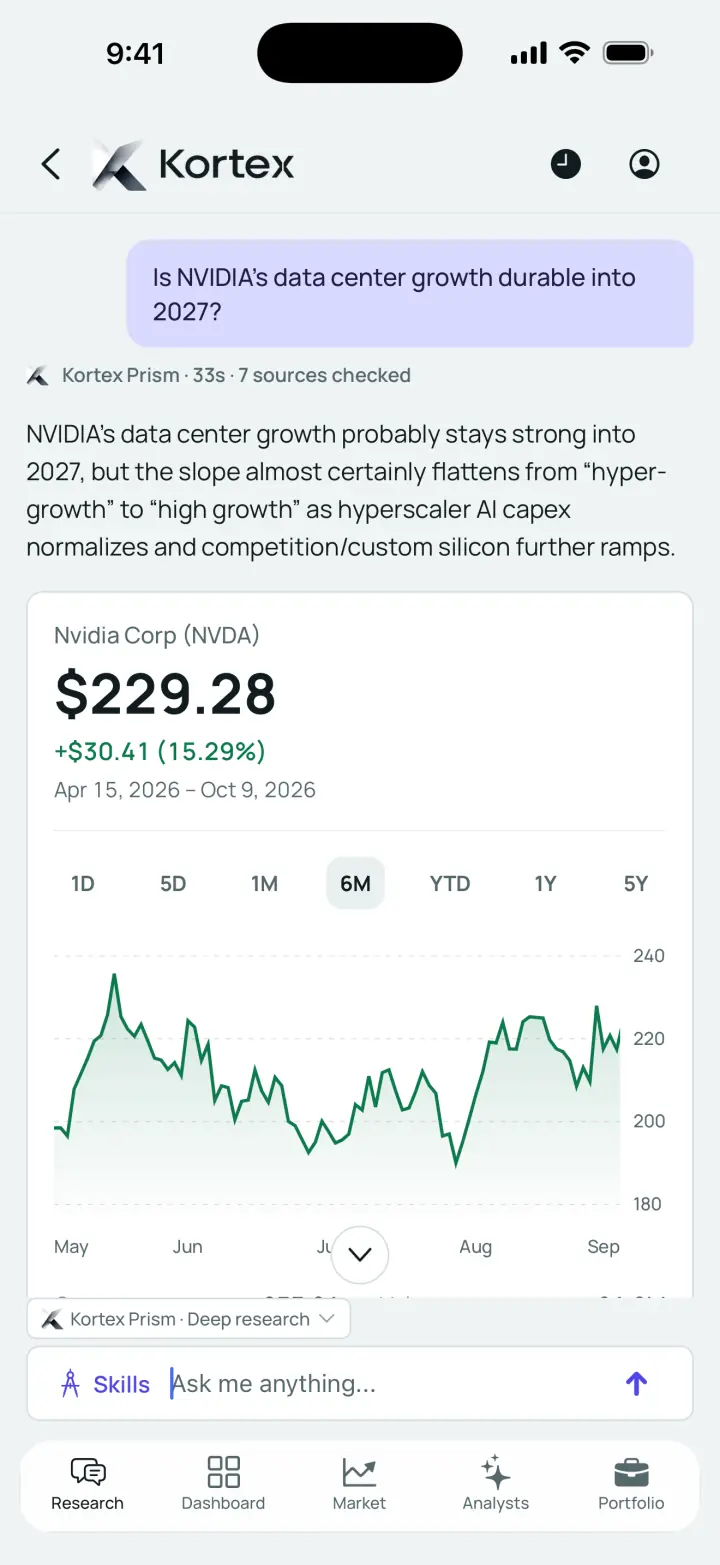
A sourced answer reads like the checklist above: a direct answer first, then the evidence, with the number of sources it checked shown at the top so each figure can be traced back to a filing or a quote.
A research answer in the iOS app, captured in October 2026. Answers are research, not advice.
Sources
One market note a week
What moved, what reports next, and one idea worth reading. No trade signals.
Keep reading

How to read a 10-K in 15 minutes
How to read a 10-K in 15 minutes. Which items to open, in what order, what to skip, and the warning signs in the filing worth slowing down for.
· 8 min read
Three frameworks for evaluating earnings quality
Earnings quality is how well reported profit reflects cash and lasting business. Three checks, on cash, revenue and margins, using a company's own filings.
· 8 min read
How to read a Form 4 insider filing
How to read Form 4 insider filings box by box, what each transaction code means, and how to tell an informative purchase from a routine planned sale.
· 8 min read